Companies often approach ERP as a technology decision: shortlist products, compare features, negotiate licences and begin implementation. But the most important ERP decisions are usually made before the software is selected.
An ERP can connect functions, enforce workflows and provide faster information. It can also digitise unclear processes, duplicate data, weak controls and inconsistent management practices. In that situation the organisation may end up with a newer system but the same operating problems.
The starting question should therefore not be ‘Which ERP should we buy?’ It should be: ‘How should this business operate, what information should management trust, and what decisions should the system enable?’
Software exposes operating weaknesses; it does not solve them automatically
Growth makes fragmentation visible. Sales may work from one customer list, procurement from another vendor master, production from Excel schedules, finance from accounting software and management from manually consolidated reports. People build workarounds because the formal system does not reflect the way the business actually runs.
Installing an ERP without addressing those workarounds creates a difficult choice during implementation: customise the new software to replicate the old way of working, or force users into a standard process they do not understand or trust. Both paths can be expensive.
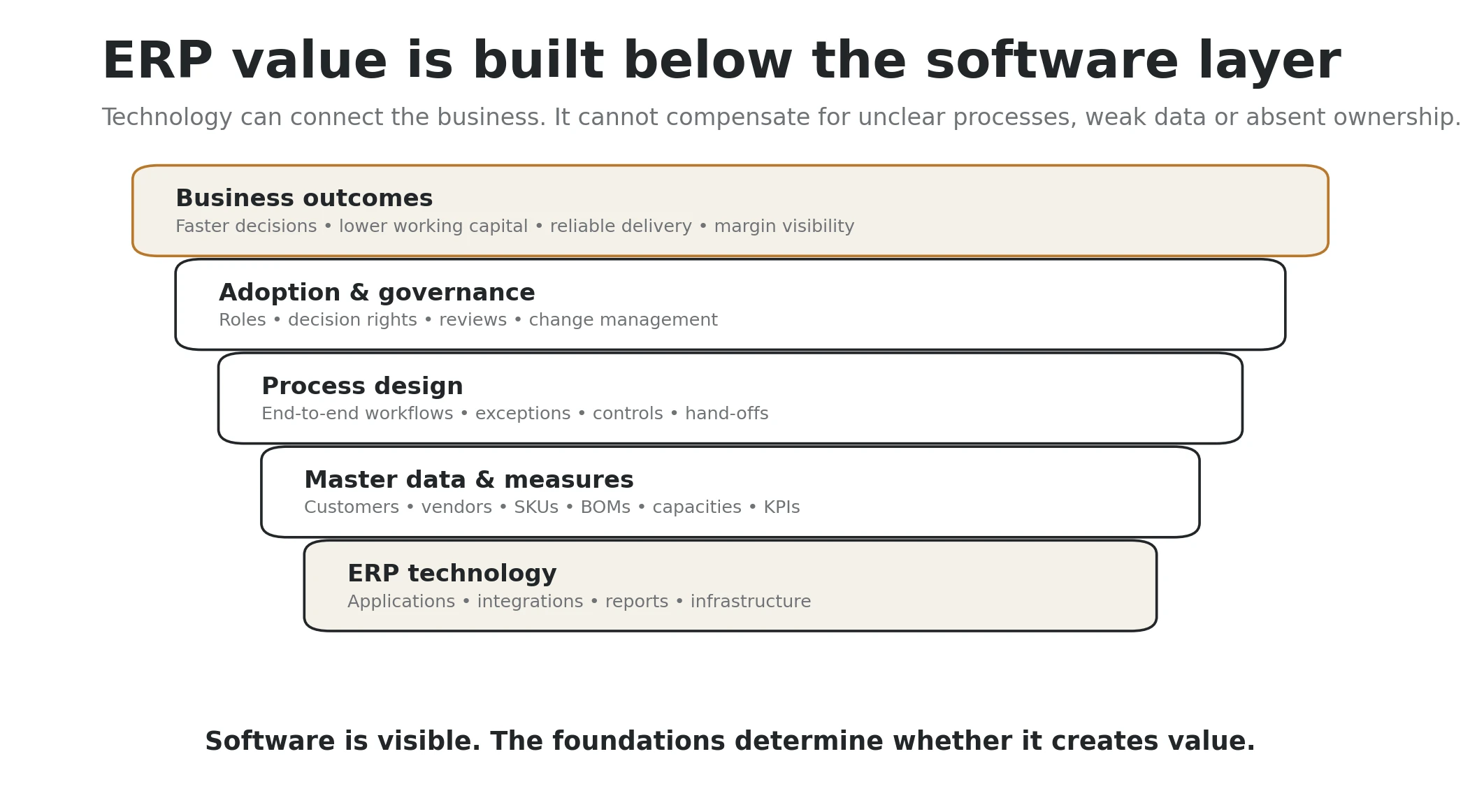
Five foundations that determine ERP value
End-to-end process design
Define how work should flow across functions—including approvals, exceptions and hand-offs—rather than documenting each department in isolation.
Reliable master data
Customers, vendors, items, bills of material, units of measure, capacities, chart of accounts and other master records need clear ownership and standards.
Controls and decision rights
The system should reflect who can create, approve, amend and override transactions, with an audit trail for material changes.
Management measures
Reports and dashboards should be designed around decisions: margin, inventory, capacity, delivery, receivables, project performance and other business outcomes.
Adoption and governance
A technically correct system still fails when people continue to operate through parallel spreadsheets, informal approvals and off-system communication.
Excel is often a symptom, not the enemy
Many ERP discussions begin with a desire to ‘remove Excel’. That is usually too simplistic. Operational teams use spreadsheets because they are flexible and because some planning or decision need is not being met elsewhere.
The useful question is why the spreadsheet exists. Is it compensating for missing functionality? Poor master data? A reporting delay? A planning process that changes every day? A lack of trust in the ERP output? The answer determines whether the right fix is process redesign, better configuration, integration, analytics or a new system.
When should management enhance the ERP—and when should it replace it?
Not every limitation requires a replacement. If the core platform is stable and the problem lies in configuration, integrations, data, controls or reporting, enhancement may deliver value faster and with less disruption.
Replacement becomes more compelling when the system fundamentally cannot support critical processes, scalability, integration, control requirements or future operating needs—or when the cost and complexity of maintaining workarounds is approaching the cost of change.
This is why an independent current-state assessment is useful before the vendor conversation begins. It separates software limitations from operating-model limitations and creates a more defensible business case.
Questions management should answer before committing capital
- Which business outcomes must improve—and how will we measure them?
- Which processes genuinely differentiate the business and which should follow standard practice?
- What data is currently unreliable or duplicated?
- Where do teams depend on spreadsheets, email or individual knowledge to complete critical work?
- Which integrations are essential for an end-to-end process?
- What controls and approvals must be strengthened?
- What behaviour must change after go-live for the benefits to materialise?
“ERP is the digital core. Competitive advantage comes from the operating model that the digital core enables.”
Make ERP a business transformation, not a software installation
The strongest ERP programmes begin with business processes and operating requirements, then use technology to make those processes visible, consistent and scalable.
This changes the tone of the programme. Vendor demonstrations become evidence against defined use cases. Customisation decisions become business decisions. Data migration becomes a management responsibility rather than an IT clean-up. Training focuses on new ways of working, not only on which buttons to click.
That is when ERP moves from being an expensive system of record to becoming an operating platform for better decisions and sustained growth.