Many growing businesses postpone HR technology because the organisation still feels ‘too small’ for an HRMS. The assumption is understandable: payroll gets processed, leave is tracked, new employees are onboarded and the team somehow manages.
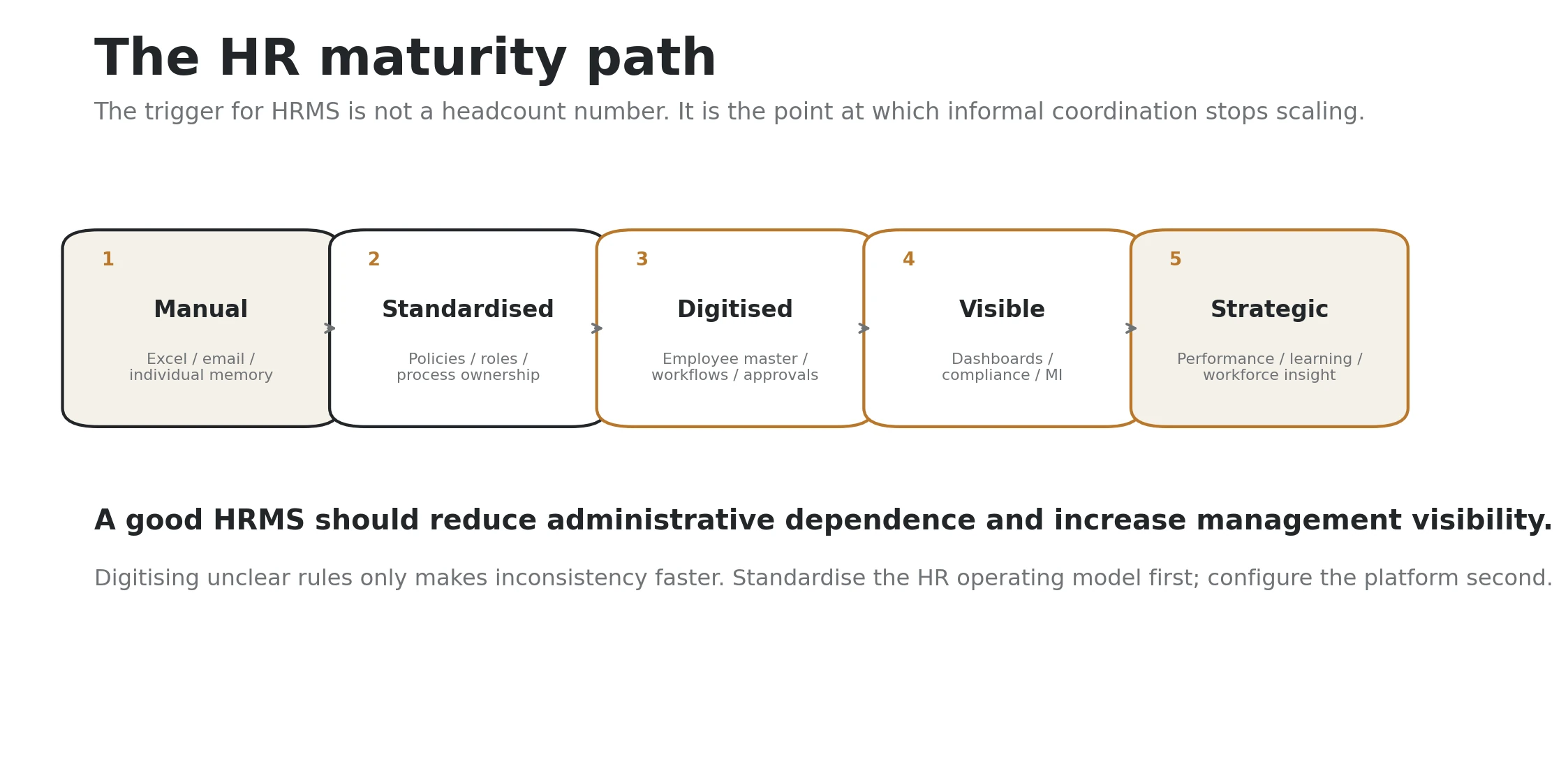
The problem is that informal coordination works—until growth makes it fragile. The real trigger for HRMS is not a specific employee count. It is the point at which employee information, approvals, compliance, performance and learning depend too heavily on spreadsheets, messages and individual memory.
At that stage, the cost is not only administrative time. Management begins to lose consistency and visibility across the employee lifecycle.
Seven signs the current HR model is no longer scaling
Employee information exists in multiple versions
Personal data, salary information, leave balances, documents and role details sit across Excel sheets, email attachments and individual folders. Simple questions require reconciliation.
Routine processes depend on one person
If payroll, leave, attendance or statutory follow-up slows down when a key employee is absent, the process is person-dependent rather than system-dependent.
Managers do not have timely workforce visibility
Headcount, absenteeism, vacancies, probation status, attrition, training completion or performance information has to be manually prepared before it can be reviewed.
Onboarding varies by manager or location
Documents, approvals, induction, system access and role expectations are completed differently across teams, creating inconsistent employee experience and avoidable compliance gaps.
Performance management happens as an annual exercise
Goals, feedback and development actions are not visible during the year, making the appraisal process more about documentation than performance.
Compliance relies on reminders and memory
Renewals, certifications, statutory records, employee documents and policy acknowledgements are followed up manually, increasing the risk of omissions.
Training is recorded but capability is not managed
Attendance sheets may show who completed a programme, but management cannot easily connect learning needs, role requirements, performance gaps and development progress.
HRMS is not just payroll software
A modern HRMS can provide a common employee record and automate routine workflows, but its real value is broader: it creates a structured operating system for how the organisation manages people.
That includes who owns employee data, how approvals work, what managers can see, how policy rules are applied, how new employees enter the organisation, how performance is reviewed and how learning and development are tracked. When these processes are clear, technology reduces dependency and makes management information available without repeated manual consolidation.
What should a growing SME digitise first?
- A clean employee master and document repository with clear data ownership.
- Attendance, leave and payroll interfaces where manual effort and errors are highest.
- Onboarding, probation, confirmation, transfer and separation workflows.
- Role-based approvals and employee/manager self-service for routine transactions.
- Performance goals, reviews and development actions.
- Training needs, learning records and capability development.
- Compliance alerts, acknowledgements and management dashboards.
Do not digitise inconsistency
One of the most common implementation mistakes is configuring the HRMS before the organisation has agreed its policies and processes. Different leave rules, inconsistent titles, duplicate employee data, unclear approval authority and outdated forms then get carried into the new platform.
Another mistake is excessive customisation. SMEs often try to reproduce every existing spreadsheet and exception inside the software. This makes implementation slower, upgrades harder and the system more dependent on the vendor.
The better sequence is to simplify the process first, decide what should be standard, clean the data, define roles and then configure the system around the future way of working.
Choose the operating model before choosing the platform
There are many affordable cloud HRMS products available to SMEs. Price and feature lists matter, but they should come after process requirements are clear.
A growing organisation should first decide which HR activities it wants to standardise, which information managers need, what employees should be able to do through self-service, what should remain with HR, and what integrations are required with payroll, finance, attendance devices or learning systems.
The best-fit HRMS is the one that supports that operating model with minimum unnecessary complexity—and that employees and managers will actually use.
From HR administration to a scalable people function
For a small team, informal communication can feel efficient. As the business grows, the same informality becomes difficult to govern and difficult to measure.
HRMS should therefore be viewed less as ‘software for a large company’ and more as a point of organisational maturity: a move from person-dependent administration to repeatable processes, reliable information and better management visibility.
That is the point at which HR technology begins to support growth rather than simply automate paperwork.