
AI has quickly become part of the customer-service agenda. Chatbots, agent copilots, automated summaries, recommendation engines and voice tools can all make service faster. But introducing AI does not automatically improve customer experience.
If the underlying process is confusing, the information is unreliable or the customer is already frustrated, automation can simply make the problem more efficient—for the company, not for the customer.
The management question should therefore not be ‘Where can we use AI?’ It should be: ‘Where is customer effort high, where is employee effort repetitive, and where can AI improve the outcome without weakening trust?’
Start with friction, not technology
Customer-service work is not one type of work. Some interactions are highly repetitive and predictable. Others require judgement, empathy, negotiation or a decision with material consequences. Treating all of them as automation opportunities is where many AI initiatives go wrong.
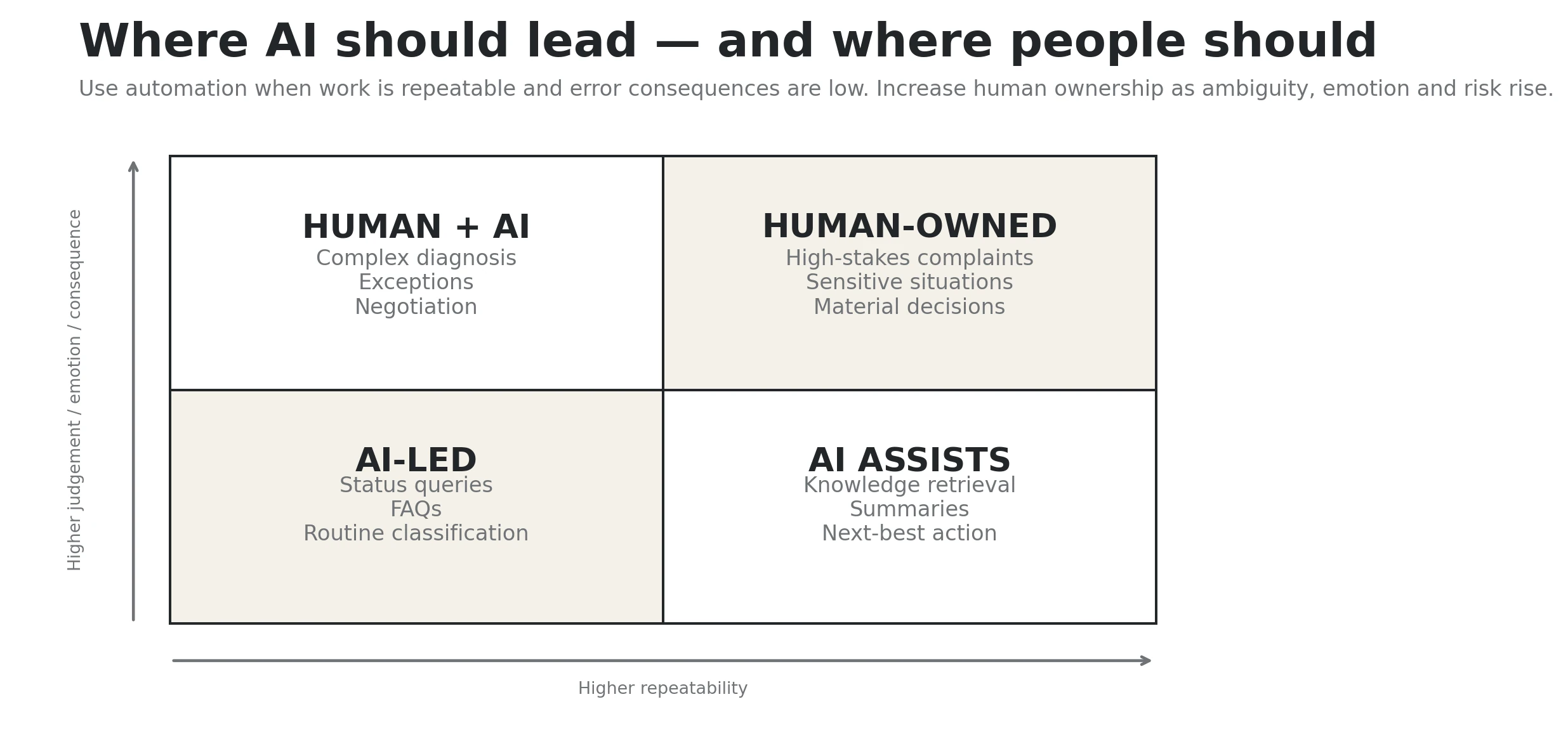
A useful way to think about AI in service is through three roles: automate routine work, assist employees in complex work, and analyse interactions at a scale that people cannot practically review manually.
Where AI can create immediate value
- Routine status and information requests: order status, appointment details, branch or service information, policy FAQs and other high-volume queries with reliable answers.
- Agent knowledge retrieval: finding the right policy, product rule, troubleshooting step or process instruction while the customer is still on the call or chat.
- Interaction summarisation: converting long calls, emails or chats into concise case notes so employees spend less time documenting and more time resolving.
- Routing and classification: identifying the subject, urgency or likely destination of an incoming request and directing it to the right team faster.
- Language support: helping employees understand and respond across languages while preserving a clear escalation path for ambiguous cases.
- Feedback analysis: clustering large volumes of complaints and comments to identify recurring friction points, emerging issues and service patterns.
Where people should continue to own the interaction
AI becomes less suitable as ambiguity, emotional intensity and consequence increase. A customer disputing a financial transaction, a patient dealing with a sensitive situation, or a long-standing client facing repeated service failure is not simply asking for information. The organisation is being asked to exercise judgement and restore confidence.
AI may still support the employee with history, summaries, policy retrieval or suggested next steps. But accountability should remain clear and human. A customer should always know how to reach a person when the automated path cannot resolve the issue.
“The best AI service design does not remove people. It removes avoidable work so people can focus on the moments that require judgement.”
Five questions before deploying an AI use case
What customer or employee effort are we trying to remove?
Begin with a measurable friction point rather than a technology feature.
Is the underlying information reliable?
AI cannot consistently give trustworthy answers when product, policy or customer data is incomplete, contradictory or inaccessible.
What is the consequence of being wrong?
The acceptable level of automation should fall as financial, regulatory, medical or reputational consequences increase.
How will the customer reach a person?
Escalation should be designed into the journey rather than added after complaints begin.
What outcome will prove that the use case works?
Measure resolution, effort and quality—not simply bot usage or the number of automated interactions.
Measure resolution, not containment
A chatbot can ‘contain’ a large percentage of contacts and still create a poor experience if customers leave without resolution or return through another channel. The same is true of agent-assist tools that employees ignore because the recommendations are slow, inaccurate or disconnected from the workflow.
For customer-facing AI, useful measures include first-contact resolution, repeat-contact rate, transfer-to-human rate, customer effort, turnaround time, quality errors and complaint recurrence. For agent-assist use cases, management should also track adoption and whether the tool genuinely reduces search, documentation or handling effort.
The real opportunity: combine digital efficiency with human judgement
The most valuable customer-service model is unlikely to be ‘AI versus people’. It is a deliberate division of work: let AI handle repetitive retrieval, summarisation, categorisation and simple transactions; let it equip employees with context and recommendations; and keep ownership with people when the situation is uncertain, emotional or consequential.
Used this way, AI becomes an operating lever for lower effort and better service rather than a technology experiment.