
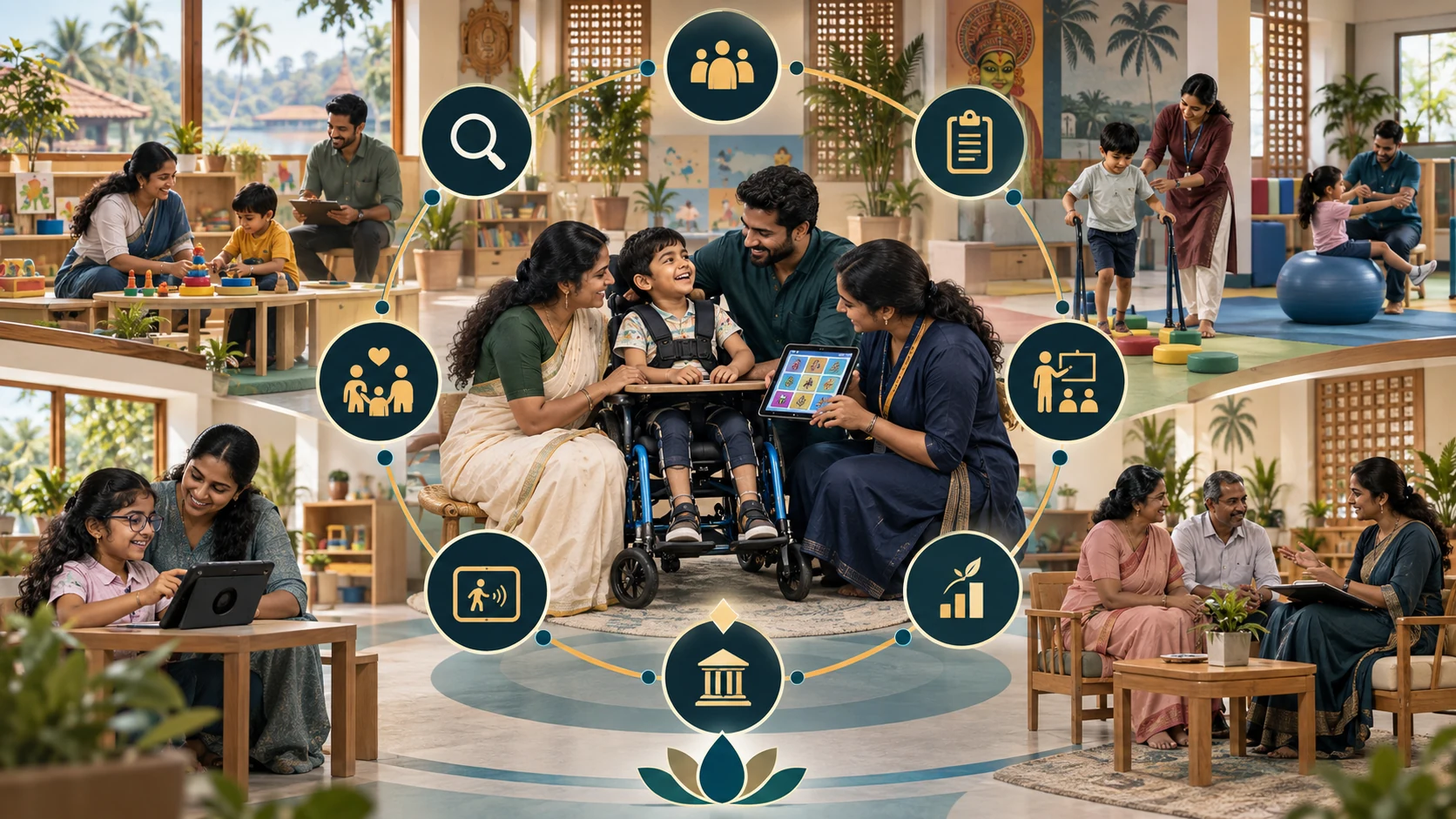
Inclusive education is sometimes reduced to admitting a learner with a disability into a mainstream classroom. Early intervention is treated as a separate therapy programme, and assistive technology as a list of devices. In practice, none of these elements can deliver sustained outcomes in isolation.
A learner and family experience one continuous journey: an early concern is noticed, needs are understood, a plan is agreed, educators and therapists deliver support, technology enables participation, progress is reviewed and the plan evolves. Every hand-off in that journey depends on an operating model.
“Inclusion becomes real when the learner can participate, progress and belong—and when the system adapts consistently enough to make that possible.”
Move from policy intent to daily delivery
India’s Rights of Persons with Disabilities Act places concrete duties on recognised and funded educational institutions: admit without discrimination, make facilities accessible, provide reasonable accommodation and individual support, monitor participation and progress, support communication needs and detect specific learning disabilities as early as possible. The Samagra Shiksha framework similarly treats inclusive education as a continuum of identification, support, accessibility, resources and teacher capacity.
Those duties are not fulfilled by a policy document alone. They require reliable roles, records, review cycles, referral pathways and decisions at classroom, centre and leadership levels. The quality of inclusion therefore depends as much on operating discipline as on professional intent.
A seven-part learner-centred operating model
Notice and screen early
Equip teachers and caregivers to record observable learning, communication, behavioural or functional concerns and initiate a timely referral. Screening identifies the need for closer assessment; it should not be presented as a clinical diagnosis.
Assess needs across disciplines
Bring together appropriate educational, therapeutic and clinical perspectives. A common intake and assessment summary prevents families from repeatedly retelling the same history and helps the team see the whole learner.
Create one individual plan
Translate assessment into a small set of meaningful participation, learning and therapy goals, with baselines, interventions, owners, review dates and clear family agreement.
Coordinate delivery
Define how educators, therapists, support staff and mainstream teachers share observations and adjust support. Timetables and hand-offs should protect continuity rather than fragment the learner’s day.
Partner with the family
Give families understandable choices, practical guidance and a dependable communication route. Consent, dignity, language and the family’s priorities should shape decisions throughout the journey.
Use assistive technology purposefully
Select tools against a specific participation barrier, train the learner and surrounding adults, ensure maintenance and accessibility, and review whether the tool improves independence in the real environment.
Review progress and govern quality
Use scheduled multidisciplinary reviews, outcome evidence and exception escalation. Leadership should see whether plans are current, services are delivered, transitions work and capacity keeps pace with need.
Early intervention is a coordinated response—not a label
Early action matters because delay can compound the barriers a learner and family encounter. But urgency must not become premature labelling. A well-designed pathway separates observation and screening from professional assessment, communicates uncertainty honestly and begins appropriate support without making unsupported claims.
India’s PRASHAST initiative provides schools with a structured screening mechanism covering the disability conditions recognised under the Act. Its operational value lies in helping teachers observe consistently and refer appropriately; the organisation still needs defined responsibility for follow-up, qualified assessment, family communication and plan activation.
Assistive technology is part of the service design
A communication application, hearing support, adapted keyboard, mobility aid or accessible learning format creates value only when it fits the learner, task and environment. Procurement without integration can leave equipment unused, unsupported or disconnected from the individual plan.
- Start with the activity the learner wants or needs to perform, not the catalogue of available devices.
- Test fit, comfort, language, accessibility and use across classroom, therapy and home environments.
- Train the learner, family and staff; assign ownership for setup, maintenance and troubleshooting.
- Protect sensitive learner information through proportionate access, consent, retention and device controls.
- Review actual participation and independence, then adapt or withdraw the tool when it no longer serves the goal.
Measure what matters to the learner
- Access
- Can participate
- Progress
- Goals advancing
- Continuity
- Support connected
- Voice
- Family involved
Attendance, sessions delivered and staff utilisation are useful operating measures, but they are not learner outcomes. The scorecard should also consider goal progress, participation, independence, transitions, family understanding, plan currency and the time from identified concern to effective support.
The management agenda
Leaders should be able to trace a learner’s journey without relying on individual memory: what was observed, who assessed it, what the current goals are, which supports were agreed, whether they were delivered, what changed and who owns the next decision. That traceability is not bureaucracy when it helps the team coordinate and the family understand.
The objective is a system that is structured without becoming rigid and personalised without becoming person-dependent. Inclusion, early intervention and assistive technology then operate as one coherent model—centred on the learner and capable of improving over time.
Primary sources
- India Code — Rights of Persons with Disabilities Act, 2016Statutory duties on inclusive education, reasonable accommodation, individual support and early detection of specific learning disabilities.
- Department of School Education & Literacy — Inclusive Education under Samagra ShikshaGovernment framework for identification, access, support, assistive resources and capacity building.
- Ministry of Education — Samagra Shiksha implementation frameworkImplementation guidance for inclusive school education and support for children with special needs.
- Ministry of Education — PRASHAST disability screening portalOfficial school screening resource supporting structured teacher observation and referral.