
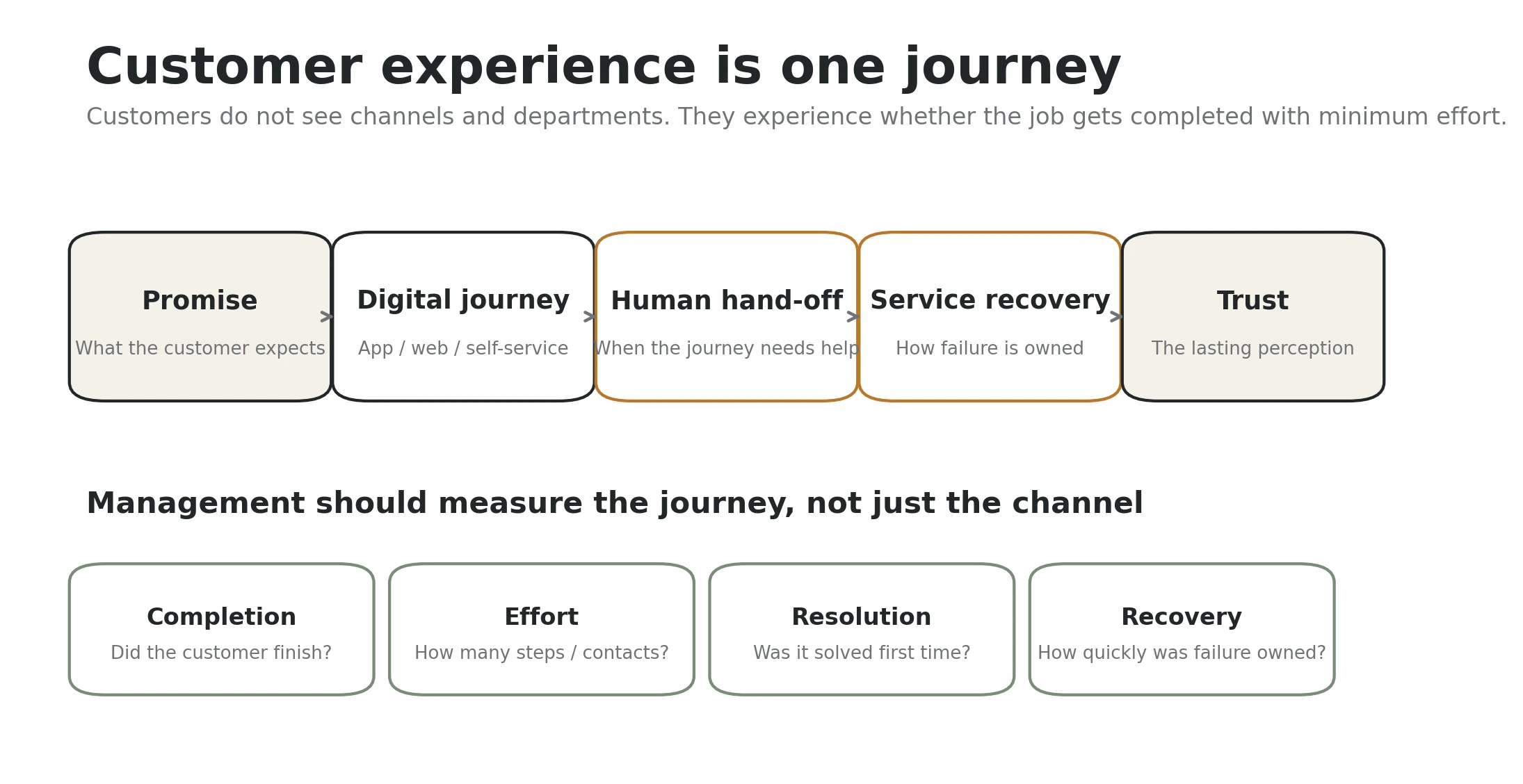
A customer does not experience a bank’s mobile app, contact centre and branch as separate departments. The customer experiences one organisation—and judges it by a much simpler question: ‘Was I able to get the job done without unnecessary effort?’
A routine salary-account onboarding experience illustrates the point. An employee had four banks to choose from. Loyalty and familiarity initially led him to a public sector bank. The first response was a mobile number. The officer advised him to download the app and complete the account opening digitally. When the app froze during document upload, the process stalled. Follow-up calls were not answered, and the journey ended there.
He then approached a private bank. The representative first asked whether he preferred an online or offline journey, shared a direct digital link and remained available during the process. When the same type of digital problem occurred, the representative took ownership, visited the office the next morning, completed the onboarding and closed the loop.
“Technology can reduce customer effort. Ownership is what protects trust when technology cannot complete the journey.”
The real failure was not the app
Both journeys had technology. Both experienced friction. The difference was what happened after the friction appeared.
This is an important distinction for management teams investing in digital customer experience. A successful digital journey is not one in which the app never fails. It is one in which the customer can still complete the intended outcome when something changes, breaks or falls outside the standard path.
The point of failure therefore sits at the intersection of process, information, accountability and human behaviour. If the digital channel cannot complete the journey, the next touchpoint must know what has already happened, who owns the case and what ‘resolved’ means.
Four moments that decide the experience
Make the choice clear
Customers should understand the available routes and the implications of each—online, assisted, branch-based or otherwise. Choice without guidance can itself create effort.
Design the hand-off
When a journey moves from app to call centre, branch to back office, or one employee to another, information should move with the customer. Repeating the same story is a visible sign of internal fragmentation.
Give someone ownership
A customer should not have to discover the organisation chart to solve a problem. Ownership means that one person or team remains responsible until the issue is completed or formally handed over.
Engineer service recovery
Failures are inevitable. What matters is the speed of acknowledgement, clarity of the next action and whether the organisation restores confidence after the disruption.
Measure the journey—not just the channel
Digital adoption, app logins and call volumes tell management what customers are using. They do not necessarily reveal whether customers are succeeding.
For important journeys such as onboarding, complaints, claims, admissions, order fulfilment or service requests, management should look at completion rate, abandonment, number of repeat contacts, first-contact resolution, turnaround time, transfer rate and service-recovery time. These measures expose the customer effort hidden behind an apparently digital process.
CX improvement starts behind the front line
Frontline training is useful, but it cannot compensate for a broken operating model. If employees do not have reliable information, decision authority, clear escalation routes or visibility of the customer’s previous interactions, even well-intentioned service becomes inconsistent.
A stronger CX programme therefore works backwards from the customer journey into the operation. Map the moments that matter. Identify waiting, rework and repeated information requests. Define ownership. Redesign hand-offs. Establish service standards. Give teams access to the information required to act. Then measure whether the new journey is actually easier for the customer.
Digital speed and human assurance should reinforce each other
The aim is not to choose between digital efficiency and human service. It is to design them as one connected experience.
Routine steps should be simple and self-service wherever possible. When a customer needs help, the organisation should recognise the context, retain the history and make the transition effortless. When the journey fails, recovery should be fast enough to preserve confidence.
That is when digital transformation stops being a channel project and becomes what the customer actually experiences: a reliable organisation.